Can Interior Design Increase ADR?

Can changing the way a hotel looks actually change what guests are willing to pay?
The answer can be yes.
Interior design alone does not determine a hotel's Average Daily Rate, or ADR. Rate is influenced by location, demand, seasonality, competition, brand, amenities, service, and many other factors.
Design is one part of that equation, but it can play an important role in how guests perceive the value of a property.
And perceived value has a direct relationship with what a guest is willing to pay.
What Is ADR?
Average Daily Rate is one of the most important metrics in hospitality. It measures the average revenue earned per occupied room over a given period.
For hotel owners, ADR provides a useful way to understand how much guests are willing to spend for the product and experience being offered.
That makes the physical product worth paying attention to.
Guests Don't Buy Square Footage
A guest booking a hotel room isn't comparing square footage alone, or sometimes at all.
They are looking at photographs. They are comparing reviews. They are considering the location, amenities, brand, room quality, atmosphere, and overall experience.
Two rooms can be similar in size and offer the same basic amenities while creating very different perceptions of value.
That perception begins with design.
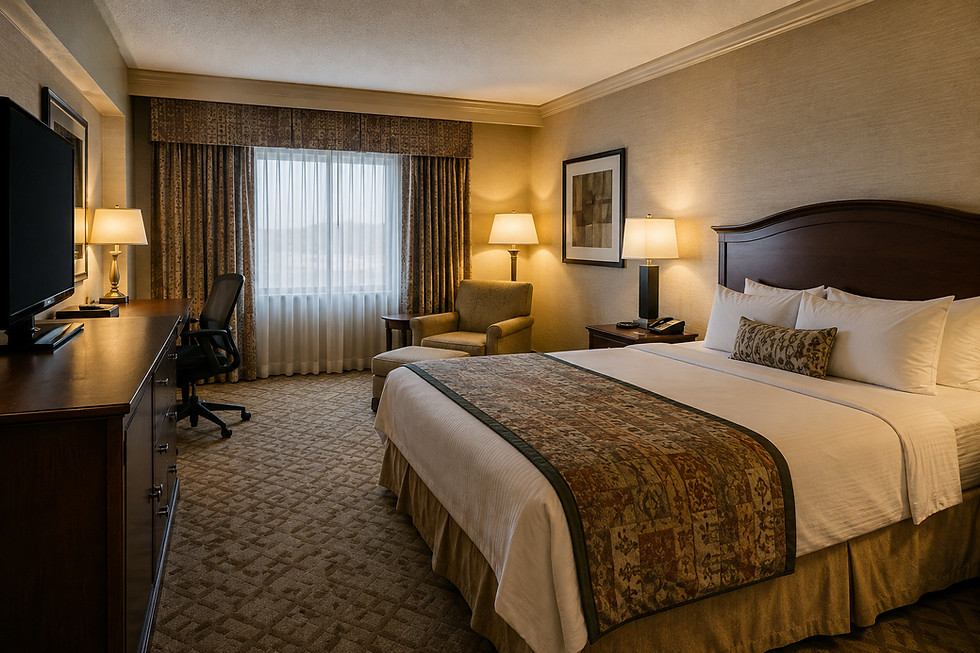
Lighting, material quality, furniture, layout, detailing, colour, artwork, and even the way a room is photographed contribute to the story a property tells.
When that story communicates quality and aligns with the property's positioning, it can support a stronger perceived value.

Design Can Influence Positioning
Consider two hotels in the same market.
One feels dated, inconsistent, and difficult to distinguish from its competitors.
The other feels considered, cohesive, and aligned with the experience it promises.
Even if the rooms are similar in size, the second property may have a much stronger reason to command a premium.
This is where design becomes part of positioning.
A hotel that wants to move upmarket needs a physical environment that supports that ambition. The design needs to communicate the level of experience the hotel is asking guests to pay for.
The Guest Experience Matters
Design influences how guests move through and experience a property.
A well-planned guestroom can feel more comfortable and intuitive. A thoughtfully designed lobby can create a stronger arrival experience. Lighting can influence atmosphere. Materials can communicate quality. Furniture can make a space feel more comfortable and functional.
These details contribute to the overall experience.
And the overall experience contributes to perceived value.
A guest may never consciously identify the exact reason a room feels more comfortable, elevated, or memorable. They simply know how it makes them feel.
That feeling matters.
Photography Is Part of the Product
The design has to make an impact before the guest ever arrives.
For many travelers, the first experience of a hotel is a photograph on a booking platform or the property's website.
Professional photography can communicate scale, atmosphere, materiality, and quality in a way that supports the actual experience.
This creates an important connection:
Design creates the experience. Photography communicates the experience.
Both influence expectations before the guest arrives.

Design Can Help You Differentiate
A hotel doesn't need to be the most luxurious property in its market to command a strong rate.
It needs to give guests a compelling reason to choose it.
That might come from a distinctive sense of place, a memorable guestroom, thoughtful public spaces, a strong brand identity, or an experience competitors aren't offering.
Design can help create that distinction.
When properties begin to look interchangeable, differentiation becomes increasingly valuable.
Where ROI Comes Into the Conversation
A renovation represents a significant capital investment, so the question should always extend beyond whether the finished space looks better.
What is the investment expected to accomplish?
Can it support a higher ADR?
Can it improve guest satisfaction?
Can it strengthen competitive positioning?
Can it increase demand?
Can it support a new target market?
Can it reduce maintenance or replacement costs?
These questions help connect design decisions to the larger business strategy.
The goal is not to spend more on design simply to create a more expensive-looking hotel.
The goal is to understand where design investment can create meaningful value for the property.
So, Can Interior Design Increase ADR?
Design can create the conditions that support stronger rate performance.
It can improve perceived value, strengthen positioning, differentiate a property, elevate the guest experience, and create a physical product that better reflects the rate being charged.
The strongest results come when design decisions are connected to a clear business objective from the beginning.
A hotel shouldn't renovate simply to look better. It should understand what the renovation needs to accomplish.
When design and business strategy work together, the result can be a property that looks better, performs better, and gives guests a stronger reason to book.
That is where interior design becomes more than an aesthetic investment.
It becomes part of the business strategy.
Written by Jasmine Bentivoglio
Founder & Principal Designer, Designology
Conceptual Imagery created for Designology Dispatch